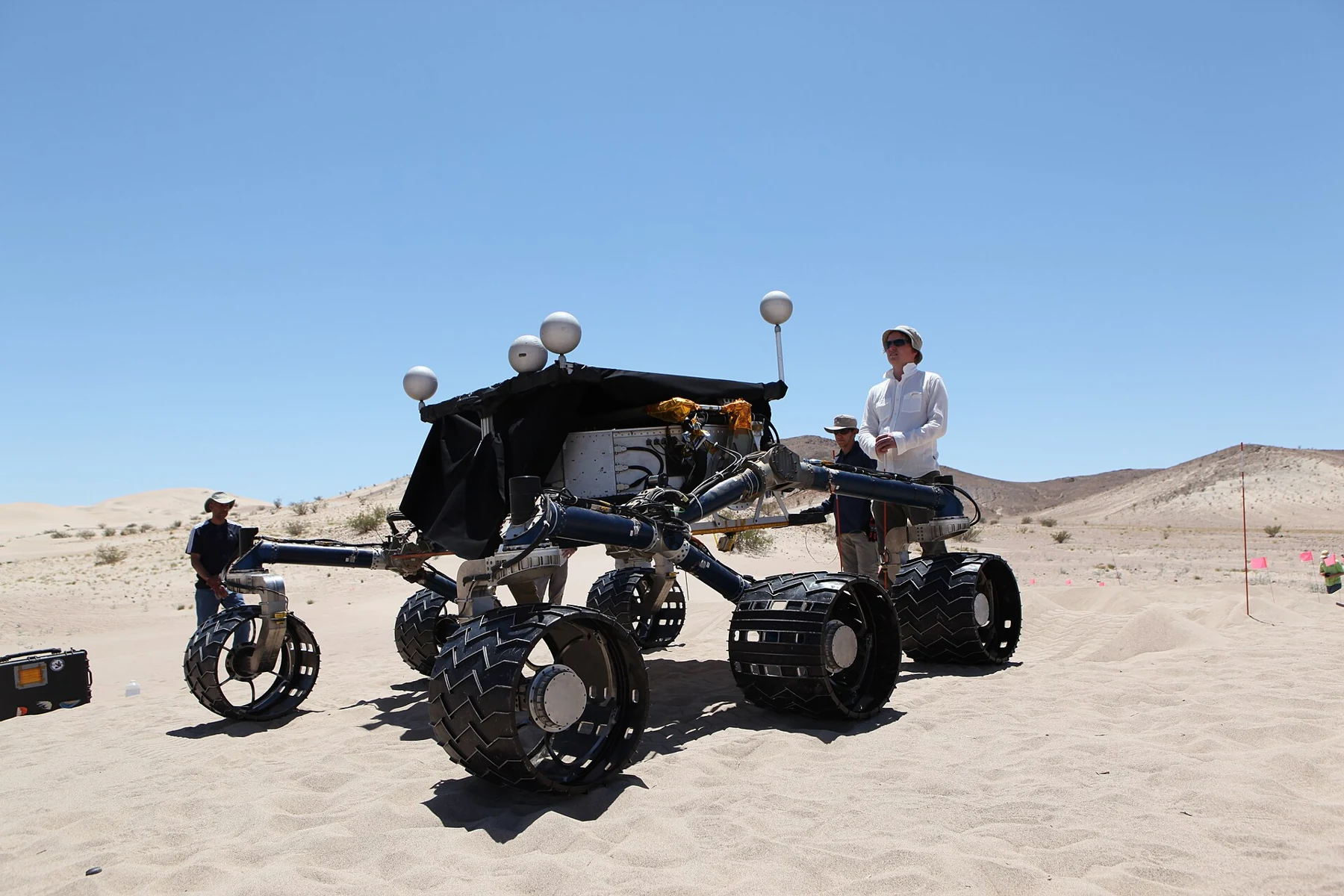
The question behind the rover
I’m designing a six-wheel rover around a question I want to test: can the suspension change stiffness before vibration forces the rover to slow down? On rough terrain, speed is only one part of the problem. The suspension also changes how disturbances reach the body and its sensors.
The design uses adjustable spring leverage to create soft, medium, and stiff settings. Each setting has a mechanical lock. A separate load path keeps the rover supported if the stiffness-changing mechanism fails, so maintaining support does not depend on successfully reconfiguring the suspension.
What changing stiffness changes
A simple mass–spring–damper model helps frame the first design decisions:
In this simplified model, m is the supported mass, c is damping, k is effective stiffness, and x is displacement from equilibrium. F(t) represents a disturbance force. The model leaves out the full rover’s wheel contacts, geometry, and terrain, but makes the relationship between support and vibration easier to examine.
Its undamped natural frequency is:
Changing spring leverage changes the effective stiffness seen at the suspension output. That can move the natural frequency, but does not mean one setting will work best on every surface. This is why I want to compare settings under the same terrain and speed conditions.
The control loop
The planned controller uses IMU and wheel-encoder data to identify sustained vibration. It requests a stiffness change, verifies the new setting, and measures the response again. If reconfiguration does not reduce the vibration enough, it can then reduce speed.
Verification matters here. Asking a mechanism to move and knowing that it reached a locked state are different things. The control design needs to account for that difference before it can make sensible decisions about speed.
The next tests
The project is in the design stage. I’m structuring validation from a single suspension unit through full rover trials. The comparison will include fixed stiffness, speed-only control, stiffness-only control, and the combined system.
Those tests should show whether reconfiguration helps, where it does not, and what it costs in time and energy. I want the next design decision to follow from those measurements.